Managing aggressive colonies in subtropical climates demands strict biological timing and protective protocols. The high humidity and dense landscape foliage in neighborhoods like Lloyd Estates and North Andrews…
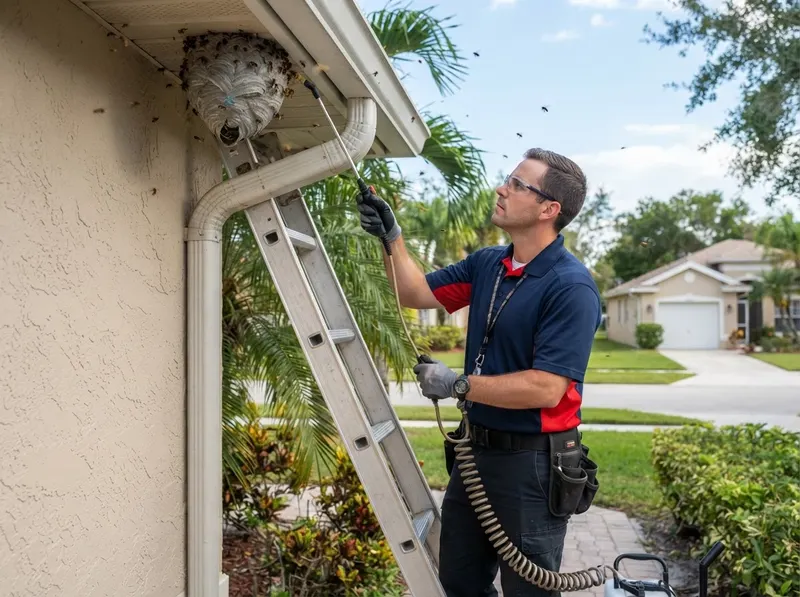
Managing aggressive colonies in subtropical climates demands strict biological timing and protective protocols. The high humidity and dense landscape foliage in neighborhoods like Lloyd Estates and North Andrews Gardens create ideal harborages for aerial hornets and social paper wasps. When colonies establish beneath second-story soffits or inside electrical disconnect boxes, store-bought sprays routinely trigger defensive swarming rather than colony death. SwiftShield Exterminating applies rapid-acting targeted compounds that neutralize the nest within minutes, preventing venomous defensive strikes against children and family pets.
Structural nesting behaviors vary significantly across local microclimates. Along canal-adjacent properties in Royal Palm Isles and Twin Lakes, persistent moisture attracts paper wasps and mud daubers to boat docks, patio overhangs, and shed rafters. Aerial bald-faced hornets favor dense canopy perimeters near Jaco Pastorius Park and Easterlin Park, weaving fiber nests that expand to over 14 inches in diameter by mid-summer. Ground-nesting yellowjackets often occupy abandoned rodent tunnels or hollowed roots throughout Oakland Forest and Harlem McBride, creating camouflaged hazards for lawn maintenance mowers. Technicians locate subterranean nests using non-invasive thermal verification before neutralizing the queen and core brood chambers.
Effective removal requires physical extraction combined with localized repellency to halt secondary pest invasions. Abandoned comb material contains high levels of proteins and sugars that attract roaches, secondary ants, and carpet beetles if left inside attics or wall cavities. In older wood-frame and concrete block structures across Central Corals, Lake Oakland, and Corals, yellowjackets exploit structural weep holes and cracked stucco along window trims. Following physical removal, perimeter exclusion seals structural access points using copper mesh or elastomeric sealants, ensuring new fertilizing queens cannot repopulate the existing void.
Technical standards govern all pesticide selection and applicator safety around South Florida residences. Specialized insect growth regulators and knockdown dusts are applied according to strict safety guidance from the EPA Pesticide Safety Division. Property managers near Oakland Park City Hall and Wimberly Field can review general municipal code enforcement via the City of Oakland Park Official Portal. Regional pest tracking and structural pest management directives follow standards established by the Florida Department of Agriculture and Consumer Services (FDACS). In-depth entomological identification guidelines for stinging Hymenoptera are maintained by the University of Florida IFAS Entomology Department and the Entomological Society of America. Structural treatment techniques and worker safety criteria align with the National Pest Management Association and Occupational Safety and Health Administration (OSHA). Wildlife protection guidelines adhere to the Florida Fish and Wildlife Conservation Commission, while broader environmental pollinator protections reference the U.S. Fish and Wildlife Service and the Pollinator Partnership.
Every job gets a firm, written price after a free on-site visit.
For standards, safe disposal, and service guidance on pest control services in Oakland Park, FL, useful references include U.S. EPA, ENERGY STAR, U.S. Dept. of Energy, Consumer.gov, U.S. Census Bureau, and Google Maps. General consumer and small-business resources are available from USA.gov, Better Business Bureau, FTC Consumer Advice, U.S. Small Business Administration, and Ready.gov.
Tell us about your stinging insect & hornet nest removal job in Oakland Park and we'll send a clear, written quote, usually the same day.
 SwiftShield Exterminating