Roof rat populations thrive in South Florida due to subtropical moisture, thick tree canopies, and architectural designs featuring barrel-tile rooflines, fascia voids, and open soffit intersections. In dense…
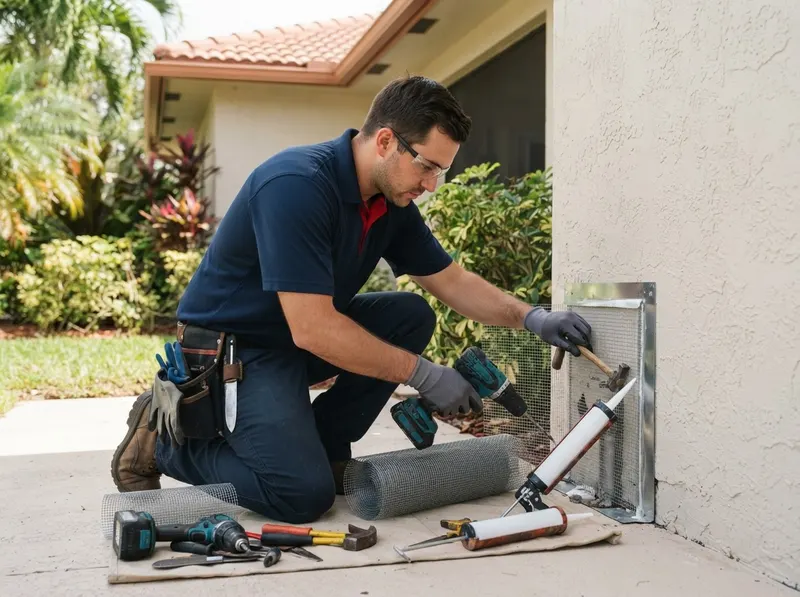
Roof rat populations thrive in South Florida due to subtropical moisture, thick tree canopies, and architectural designs featuring barrel-tile rooflines, fascia voids, and open soffit intersections. In dense neighborhoods like North Andrews Gardens, Lloyd Estates, and Oakland Forest, citrus canopies and overhead power lines provide elevated runways directly onto single-family asphalt and tile roofs. Adult roof rats require only an opening measuring 0.5 inches, roughly the diameter of a standard nickel, to slip past soffits into attic insulation. Exclusion addresses these structural vulnerabilities directly rather than relying on rodenticides, which carry severe risks of secondary toxicity to domestic animals and leave carcasses decaying inside inaccessible wall cavities during 90-degree summer heat.
Structural fortification follows specific construction metrics. Technicians install 18-gauge, 1/4-inch hot-dipped ASTM International galvanized hardware cloth behind gable vents, air-conditioning chase entries, and sub-roof eaves. Polyurethane architectural foams alone fail because adult rodents gnaw through cured foam within 72 hours; therefore, mechanical barriers pair copper mesh underlayment with high-tensile elastomeric sealants meeting Florida Building Commission wind-load standards. In waterfront zones like Royal Palm Isles and Twin Lakes, foundation weep screeds and plumbing stubs beneath pier-and-beam floors require stainless steel escutcheon plates to block Norway rats moving upward from canal banks. Properties near Jaco Pastorius Park and Central Corals frequently show gnaw scoring along PVC conduit runs, which technicians cap with custom-bent aluminum flashing.
Once technicians mechanically seal the exterior building envelope, an interior mechanical trapping protocol removes trapped animals within 7 to 14 days without poison bait blocks, complying with guidelines from the Centers for Disease Control and Prevention for hantavirus and leptospirosis risk reduction. The exclusion protocol concludes with localized biological enzyme treatment along scent trails to neutralize pheromones that attract outside colonies. If rodent activity has degraded blown-in fiberglass or cellulose insulation, spot remediation restores thermal resistance values outlined by the U.S. Department of Energy while removing contaminated nesting material.
Every job gets a firm, written price after a free on-site visit.
For standards, safe disposal, and service guidance on pest control services in Oakland Park, FL, useful references include U.S. EPA, ENERGY STAR, U.S. Dept. of Energy, Consumer.gov, U.S. Census Bureau, and Google Maps. General consumer and small-business resources are available from USA.gov, Better Business Bureau, FTC Consumer Advice, U.S. Small Business Administration, and Ready.gov.
Tell us about your rodent & roof rat structural exclusion job in Oakland Park and we'll send a clear, written quote, usually the same day.
 SwiftShield Exterminating